

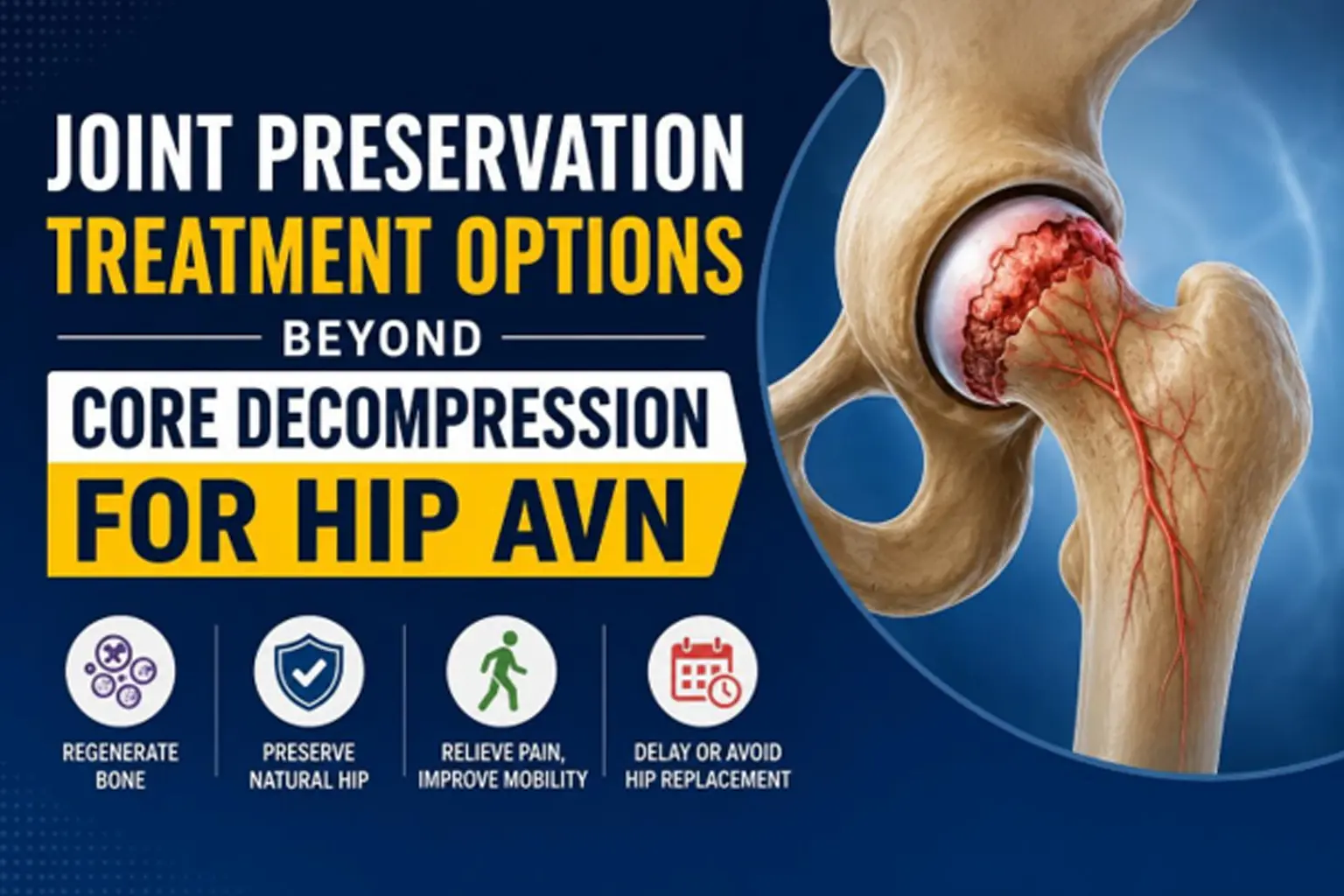
Joint Preservation Treatment Options Beyond Core Decompression for Hip AVN
Introduction
Being diagnosed with avascular necrosis of the hip can feel overwhelming, especially for young and active individuals worried about losing mobility or needing an early hip replacement. While core decompression is one of the most commonly discussed treatments for early-stage AVN, it is not the only joint preservation option available today.
Advancements in orthopedic surgery, regenerative medicine, and hip preservation techniques now offer multiple treatment pathways designed to preserve the natural hip joint, reduce pain, and delay or avoid total hip replacement.
At the Center for Sports Injury, our orthopedic specialists focus on evidence-based, patient- centered treatment plans tailored to the stage of AVN, bone quality, lifestyle demands, and long-term joint health goals.
In this guide, we explain the most effective joint preservation treatments available beyond core decompression for hip AVN and how early intervention can improve outcomes.
Understanding Hip AVN
Avascular necrosis (AVN), also called osteonecrosis, occurs when blood supply to the femoral head is disrupted, causing bone tissue to weaken and collapse over time.
Common causes include:
- Steroid use
- Alcohol abuse
- Hip trauma or fractures
- Autoimmune disorders
- Sickle cell disease
- Long-term medication use
- Idiopathic (unknown causes)
Without timely treatment, AVN can progress to femoral head collapse and severe arthritis, eventually requiring total hip replacement.
Why Joint Preservation Matters
For younger and physically active patients, preserving the native hip joint is often preferred over early replacement surgery.
Joint preservation procedures aim to:
- Reduce pain
- Restore blood flow
- Prevent femoral head collapse
- Maintain mobility
- Delay or avoid hip replacement
- Improve long-term quality of life
The success of these procedures depends heavily on:
- Early diagnosis
- Stage of AVN
- Size of the lesion
- Cartilage condition
- Patient compliance with rehabilitation
Joint Preservation Treatments Beyond Core Decompression
1. Biologic Augmentation and Stem Cell Therapy
One of the most promising advancements in hip preservation is the use of biologic therapies alongside decompression or minimally invasive procedures.
These may include:
- Bone marrow aspirate concentrate (BMAC)
- Mesenchymal stem cells
- Platelet-rich plasma (PRP)
The goal is to stimulate bone healing, improve regeneration, and enhance blood supply to the affected femoral head.
Potential benefits include:
- Faster healing response
- Improved bone remodeling
- Reduced progression of AVN
- Better outcomes in early-stage disease
Stem cell–based procedures are increasingly being used in selected patients with early AVN who want to preserve joint function and remain active.
2. Vascularized Bone Grafting
Vascularized bone grafting involves transferring healthy bone tissue along with its blood supply to the damaged femoral head.
This procedure helps:
- Restore circulation
- Support weakened bone
- Promote structural healing It is typically recommended for:
- Young patients
- Medium-sized lesions
- Early to mid-stage AVN without major collapse
Compared to traditional grafting methods, vascularized grafts may offer improved biological healing because they bring living blood vessels into the affected area.
3. Non-Vascularized Bone Grafting
In some cases, surgeons may use bone grafts to fill the necrotic area after removing damaged tissue.
This procedure provides:
- Mechanical support
- Structural reinforcement
- Reduced risk of collapse
Bone grafting is often combined with decompression procedures to improve overall outcomes.
4. Osteotomy Procedures
Osteotomy is a joint-preserving surgery that repositions the femoral head to shift weight- bearing forces away from the damaged area.
This option may be considered in carefully selected patients with:
- Localized AVN lesions
- Minimal arthritis
- Preserved cartilage
Although technically demanding, osteotomy can delay hip replacement in younger individuals by preserving healthy portions of the joint surface.
5. Hip Arthroscopy-Assisted Procedures
Hip arthroscopy may be used in combination with preservation techniques to:
- Evaluate cartilage damage
- Address impingement
- Treat labral injuries
- Improve joint mechanics
Minimally invasive arthroscopic approaches can help optimize outcomes in selected AVN patients with associated hip pathology.
6. Pharmacological and Non-Surgical Management
While surgery may be necessary in many cases, early-stage AVN management may also include:
- Activity modification
- Protected weight-bearing
- Physiotherapy
- Anti-inflammatory medications
- Bisphosphonates in selected cases
These approaches aim to reduce stress on the hip and slow disease progression.
Who Is the Ideal Candidate for Joint Preservation?
Joint preservation procedures are generally more successful in patients who:
- Have early-stage AVN
- Show no significant femoral head collapse
- Are younger and active
- Have preserved cartilage
- Seek to delay hip replacement
Advanced imaging such as MRI plays a critical role in determining candidacy and treatment planning.
When Is Hip Replacement Necessary?
Despite advances in preservation surgery, total hip replacement may still become necessary when:
- The femoral head collapses
- Severe arthritis develops
- Pain becomes debilitating
- Joint preservation procedures are unlikely to succeed
However, early intervention can significantly delay the need for replacement surgery in many patients.
Importance of Early Diagnosis
The earlier AVN is detected, the greater the opportunity to preserve the natural hip joint. Warning signs include:
- Groin pain
- Hip stiffness
- Limping
- Pain during walking or activity
- Reduced hip movement
MRI remains one of the most sensitive diagnostic tools for early AVN detection before X- rays show major changes.
Why Choose Center for Sports Injury for Hip AVN Treatment?
At Center for Sports Injury, our orthopedic and hip preservation specialists use advanced diagnostic techniques and evidence-based treatment protocols to create individualized treatment plans for patients with hip AVN.
Our approach emphasizes:
- Early diagnosis
- Joint preservation whenever possible
- Minimally invasive techniques
- Advanced regenerative options
- Comprehensive rehabilitation
- Long-term mobility and function
We work closely with each patient to identify the most suitable treatment strategy based on disease stage, age, activity level, and lifestyle goals.
Frequently Asked Questions
Can AVN heal without surgery?
Very early-stage AVN may be managed conservatively, but many patients eventually require intervention to prevent progression.
Is stem cell therapy effective for hip AVN?
Stem cell–based therapies show promising results in selected early-stage AVN patients, especially when combined with joint-preservation procedures.
Can joint preservation avoid hip replacement permanently?
In some patients, preservation procedures can significantly delay or prevent the need for hip replacement, especially when treated early.
What is the best treatment for early-stage hip AVN?
Treatment depends on lesion size, stage, symptoms, and patient factors. Early-stage disease may respond well to biologic augmentation, grafting procedures, or decompression-based techniques.
Conclusion
Hip AVN does not always mean an immediate hip replacement. Today, several advanced joint preservation strategies beyond core decompression can help maintain joint integrity, reduce pain, and improve long-term mobility.
From biological therapies and bone grafting to osteotomy and minimally invasive procedures, modern orthopedic care offers new possibilities for preserving the natural hip joint.
If you are experiencing persistent hip pain or have been diagnosed with AVN, early specialist evaluation is critical for achieving the best possible outcome.
Book a Consultation
To learn more about advanced hip preservation treatments for AVN, contact the Center for Sports Injury and schedule an expert orthopedic evaluation today.