
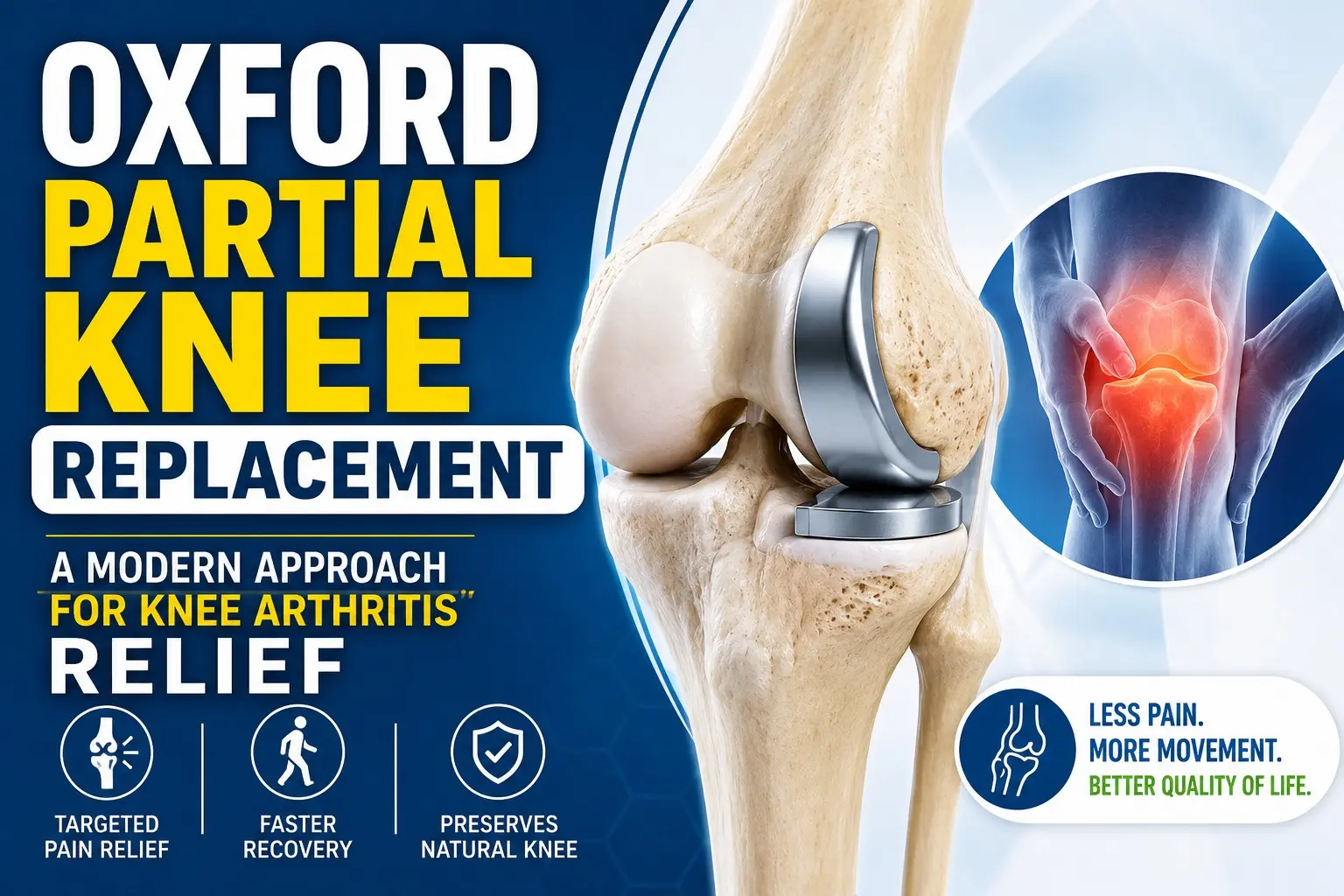
Oxford Partial Knee Replacement A Modern Approach for Knee Arthritis Relief
Knee pain can slowly affect every part of daily life. Walking, climbing stairs, exercising, or even standing for long periods may become difficult when arthritis damages the knee joint. While many people assume that severe knee pain always requires a total knee replacement, that is not always true. In many cases, only one part of the knee is affected. This is where Oxford partial knee replacement becomes an effective and advanced treatment option.
At Center For Sports Injury, patients receive comprehensive orthopedic and sports injury care supported by advanced imaging, minimally invasive procedures, rehabilitation, and joint replacement expertise under one roof.
What Is Oxford Partial Knee Replacement
Oxford partial knee replacement is a minimally invasive surgical procedure designed for patients who have arthritis limited to only one compartment of the knee. Instead of replacing the entire knee joint, the damaged section is resurfaced with specialized implants while preserving healthy bone, cartilage, and ligaments.
This technique is widely known for allowing more natural knee movement compared to traditional total knee replacement. Because healthy parts of the knee remain intact, many patients experience better mobility and a quicker return to normal activities.
The Oxford implant is specifically designed to mimic the natural movement of the knee. It uses a mobile bearing system that supports smoother motion and reduces stress on the implant during movement.
Who May Need Oxford Partial Knee Replacement
Not every patient with knee arthritis requires a full knee replacement. Oxford partial knee replacement may be recommended for individuals who have:
- Arthritis affecting only one side of the knee
- Persistent knee pain despite medications and physiotherapy
- Difficulty walking or climbing stairs
- Knee stiffness and reduced mobility
- Good ligament stability in the knee
- Minimal deformity in the joint
An orthopedic specialist typically evaluates the knee using physical examination, X rays, and advanced imaging before deciding whether partial knee replacement surgery is the right option. At Center For Sports Injury, advanced orthopedic assessment and diagnostic imaging help determine the most suitable treatment plan for each patient.
Benefits of Oxford Partial Knee Replacement
One of the biggest advantages of Oxford partial knee replacement is that it preserves healthy knee structures. This allows patients to experience more natural movement after surgery.
Some important benefits include:
Smaller Incision and Less Tissue Damage
Because only the damaged portion of the knee is treated, the surgery is less invasive compared to total knee replacement.
Faster Recovery
Many patients begin walking sooner and return to routine activities faster after surgery.
More Natural Knee Function
Since healthy ligaments and bone are preserved, the knee often feels more natural during movement.
Reduced Blood Loss
The minimally invasive nature of the procedure generally leads to less blood loss during surgery.
Shorter Hospital Stay
Patients may spend less time in the hospital compared to traditional knee replacement procedures.
Better Range of Motion
Many patients regain excellent knee flexibility after rehabilitation.
How the Procedure Is Performed
During Oxford partial knee replacement surgery, the orthopedic surgeon removes the damaged cartilage and a small amount of bone from the affected compartment of the knee. Specialized implants are then placed to restore smooth movement and reduce pain.
Modern orthopedic centers may use advanced technologies such as robotic assistance and precision based surgical planning to improve implant positioning and alignment.
At the Center For Sports Injury, joint replacement procedures are supported by advanced surgical infrastructure and modern orthopedic technology designed to improve precision and recovery outcomes.
Recovery After Partial Knee Replacement Surgery
Recovery plays a major role in achieving long term success after knee surgery. Most patients are encouraged to start gentle movement soon after the procedure.
Initial Recovery
Patients may begin standing and walking with support within a short time after surgery.
Physiotherapy and Rehabilitation
Structured physiotherapy helps improve strength, flexibility, and balance. Rehabilitation is important for restoring normal movement patterns and preventing stiffness.
Returning to Daily Activities
Many individuals can return to routine activities within a few weeks, although complete recovery may take several months depending on overall health and activity levels.
Comprehensive rehabilitation support is often essential for optimal results. Center For Sports Injury Physiotherapy Services provides rehabilitation and sports physiotherapy programs tailored for orthopedic recovery.
Oxford Partial Knee Replacement vs Total Knee Replacement
Both procedures aim to reduce pain and improve mobility, but they are used for different conditions.
|
Feature |
Partial Knee Replacement |
Total Knee Replacement |
|
Area treated |
Only damaged compartment |
Entire knee joint |
|
Surgical approach |
Minimally invasive |
More extensive |
|
Recovery time |
Usually faster |
Often longer |
|
Bone preservation |
Preserves healthy bone |
More bone removal |
|
Knee movement |
More natural feel |
Artificial joint feel possible |
The right option depends on the severity and location of arthritis, lifestyle needs, and overall knee condition.
How to Know If You Are a Suitable Candidate
A detailed orthopedic evaluation is necessary before deciding on surgery. Patients who continue to experience knee pain despite medications, injections, weight management, or physiotherapy
may benefit from further assessment.
Factors such as age, activity level, ligament stability, and the extent of arthritis influence treatment decisions.
Experienced orthopedic and sports injury specialists use imaging and clinical evaluation to determine whether partial knee replacement surgery can provide long lasting relief.
Why Choose Expert Orthopedic Care for Knee Replacement
Choosing the right orthopedic center is extremely important for successful outcomes. A multidisciplinary approach involving orthopedic surgeons, physiotherapists, sports rehabilitation experts, and advanced diagnostic support helps improve recovery and long term joint function. Center For Sports Injury is an advanced orthopedic and sports medicine center in South Delhi offering joint replacement surgery, sports injury treatment, physiotherapy, and rehabilitation services with a patient focused approach.
Conclusion
Oxford partial knee replacement is an advanced and effective treatment option for patients with arthritis limited to one part of the knee. By preserving healthy bone and ligaments, this minimally invasive procedure helps many patients experience faster recovery, reduced pain, and improved mobility.
Early diagnosis and expert orthopedic evaluation are important for identifying the right treatment approach. Patients experiencing persistent knee pain should seek professional consultation before arthritis affects their quality of life further.
For advanced orthopedic care, joint replacement expertise, and personalized rehabilitation support, patients can consult Center For Sports Injury in Delhi NCR.
FAQs
1. What is Oxford partial knee replacement?
Oxford partial knee replacement is a minimally invasive surgery that replaces only the damaged part of the knee while preserving healthy bone and ligaments.
2. Who is a suitable candidate for partial knee replacement surgery?
Patients with arthritis affecting only one compartment of the knee and stable ligaments may be suitable candidates.
3. How long does recovery take after Oxford partial knee replacement?
Most patients resume daily activities within a few weeks, while complete recovery may take a few months with physiotherapy.
4. Is Oxford partial knee replacement better than total knee replacement?
It can be beneficial for selected patients because it offers faster recovery, smaller incisions, and more natural knee movement.
5. Does partial knee replacement relieve knee pain permanently?
The procedure significantly reduces pain and improves mobility for many patients when combined with proper rehabilitation and follow up care.