

G-Scan MRI for Back Pain: How Weight- Bearing Imaging Helps Detect Spine Problems
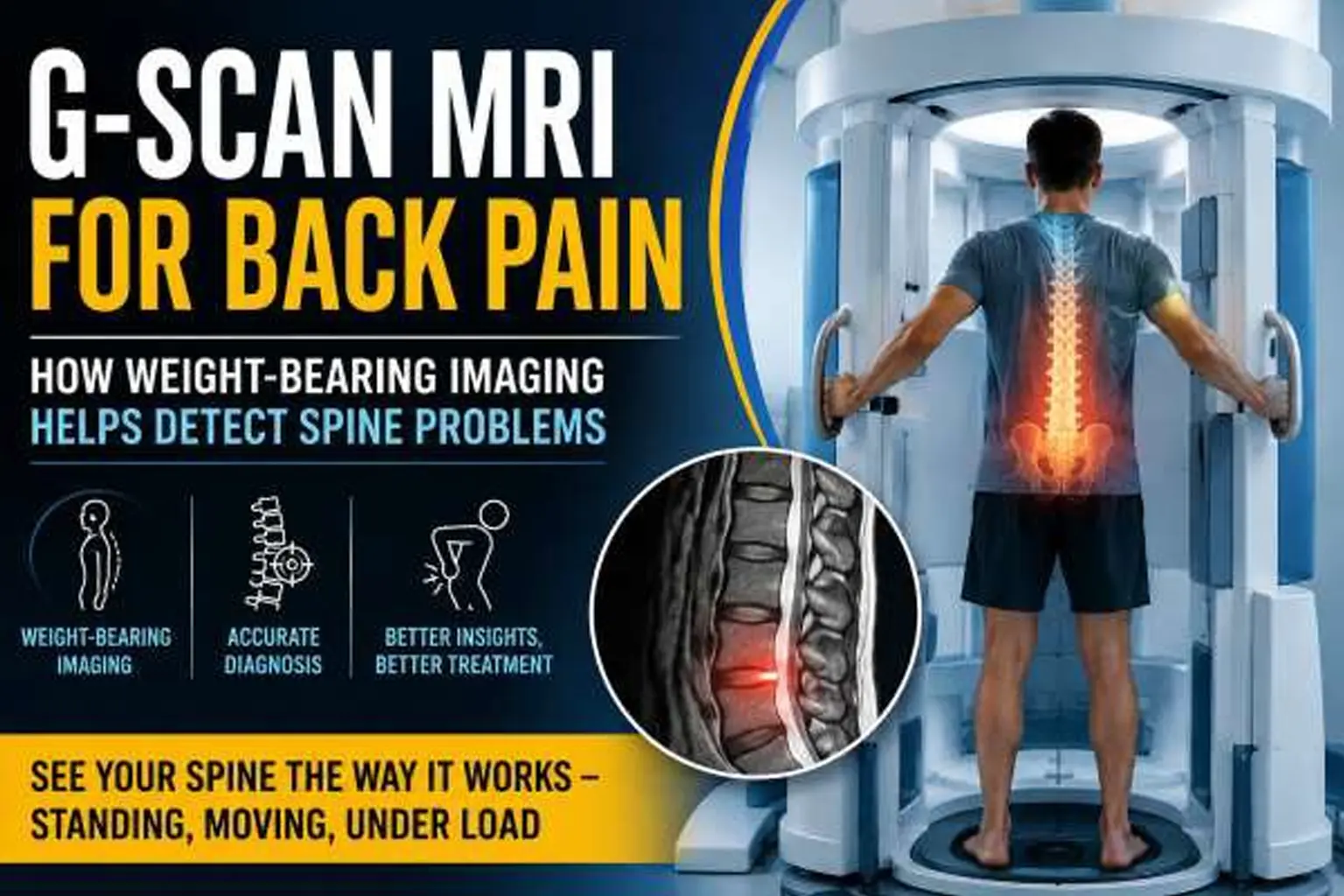
Back pain can have many possible causes, ranging from muscle strain and disc-related problems to nerve compression, spinal degeneration and sports-related injuries. While an MRI is an important diagnostic tool, the position in which the spine is examined can also matter in selected cases.
A conventional MRI generally captures images while the patient is lying down. G-Scan MRI, also known as weight-bearing or upright MRI, offers the ability to examine the spine in different positions, including weight-bearing and upright positions.
This can provide additional information about how the spine and surrounding structures behave under load. At the Center for Sports Injury (CSI) in New Delhi, advanced G-Scan
MRI technology is available for sports injuries, spine conditions and musculoskeletal evaluation.
What Is G-Scan MRI?
G-Scan is an advanced MRI system designed to perform imaging in different positions. Its open and tilting design allows imaging in horizontal and vertical positions and can facilitate weight-bearing examinations.
This is particularly relevant when a patient's symptoms are related to posture, standing, movement or loading.
Unlike a conventional MRI examination performed only in a lying position, weight-bearing MRI can provide an additional view of the anatomy when the body is placed under more natural mechanical stress.
CSI's imaging facility uses ESAOTE G-Scan technology for standing, tilting, weight-bearing and dynamic imaging for spine, joint and musculoskeletal conditions.
Why Can Weight-Bearing Imaging Matter for Back Pain?
The spine does not behave exactly the same way when a person is lying down as it does while standing or carrying body weight.
Some patients may experience:
- Back pain that increases while standing
- Pain during walking or physical activity
- Symptoms that improve when lying down
- Leg pain or sciatica associated with certain positions
- Persistent symptoms despite previous imaging
In selected cases, imaging the spine in a weight-bearing position can provide additional information about positional or load-related changes.
It is important to understand that G-Scan is not automatically better than conventional MRI for every patient. The appropriate imaging technique depends on the patient's symptoms, examination and the clinical question the doctor needs to answer.
What Spine Problems Can G-Scan MRI Help Evaluate?
Depending on the clinical situation and imaging protocol, weight-bearing MRI may provide useful information when evaluating conditions involving the spine and surrounding structures.
These may include:
1. Disc-Related Problems
Disc bulges and herniations can contribute to back pain, leg pain and nerve-related symptoms. In selected patients, weight-bearing imaging may provide additional information about how the spine behaves under load.
2. Spinal Narrowing
Changes in spinal spaces can sometimes become more pronounced with loading or changes in posture. Weight-bearing imaging may help provide additional information in appropriate cases.
3. Spinal Instability
If a doctor suspects that spinal alignment or stability changes with position, imaging in different positions can provide useful diagnostic information.
4. Posture-Related Back Pain
Some patients experience significantly different symptoms while standing compared with lying down. A weight-bearing examination can help clinicians assess the spine in a position that may better reproduce those symptoms.
5. Sports-Related Spine Injuries
Athletes and active individuals can develop back problems due to repetitive loading, sudden movements, training errors or sports injuries. At CSI, MRI services are specifically designed around sports and musculoskeletal conditions.
G-Scan MRI vs Traditional MRI: What Is the Difference?
The key difference is how and where the body can be positioned during imaging.
| Feature | Conventional MRI | G-Scan MRI |
| Lying-down imaging | Yes | Yes |
| Upright imaging | Generally limited | Available |
| Weight-bearing imaging | Generally unavailable | Available |
| Tilting positions | Limited | Available |
| Dynamic imaging options | Limited depending on system | Available with appropriate protocols |
| Open design | Depends on equipment | Yes |
A conventional MRI remains highly valuable for many spinal conditions. G-Scan provides an additional imaging approach when a doctor needs to understand how anatomy may behave in a weight-bearing or upright position.
When Might a Doctor Recommend a G-Scan MRI?
G-Scan may be considered when the clinical picture suggests that positional or weight- bearing information could be useful.
A doctor may consider it for patients with:
- Persistent lower back pain
- Recurrent back pain during activity
- Sciatica or radiating leg pain
- Suspected disc-related problems
- Sports-related spine injuries
- Symptoms that change with posture
- Suspected spinal instability
- Symptoms that do not completely correlate with previous imaging findings
The decision should always be made by a qualified medical professional after reviewing the patient's history and clinical examination.
How Does G-Scan MRI Help in Sports Injury Evaluation?
For athletes, symptoms often appear during activity rather than while resting.
A runner may experience pain while standing or running. A cricketer may develop symptoms during repeated bending or rotation. A gym enthusiast may experience back pain while lifting weights.
Because G-Scan can provide imaging in different positions, it may offer additional information about certain musculoskeletal problems under weight-bearing conditions.
CSI focuses specifically on sports injury and musculoskeletal care and provides dedicated MRI services, including G-Scan weight-bearing MRI and O-Scan joint MRI.
Is G-Scan MRI More Comfortable Than a Conventional MRI?
Patient comfort can be an important consideration when undergoing an MRI.
CSI's G-Scan system has an open design and can be positioned according to the examination being performed. This can make the experience more accessible for some patients who are uncomfortable with the enclosed environment of a conventional MRI scanner.
CSI describes its G-Scan technology as offering an open and patient-friendly MRI environment, with weight-bearing and dynamic imaging capabilities.
However, MRI suitability depends on individual factors, including medical history, implants and the specific examination required.
The Role of Expert Clinical Assessment
Advanced imaging is most useful when it is combined with proper clinical evaluation.
A scan should not be viewed in isolation. Doctors consider the patient's symptoms, physical examination, medical history and imaging findings together before determining the most appropriate treatment approach.
At the Center for Sports Injury, imaging is part of a broader sports medicine and orthopedic care approach. The centre's team works across sports injuries, orthopedic conditions, rehabilitation and musculoskeletal care.
Under the clinical leadership of Dr. Pushpinder Singh Bajaj, Founder, Chairman and Managing Director of CSI, the centre integrates orthopedic, sports medicine and advanced diagnostic services. Dr. Bajaj's qualifications include MS (Orthopaedics), DNB (Orthopaedics), FIAS (UK), MSc Orth (UK), AO Fellowship (Germany), Dipl. Sports Medicine (UK), and fellowships in arthroscopy and joint replacement from Australia.
Why Choose Center for Sports Injury for G-Scan MRI in Delhi?
If you have been advised to undergo weight-bearing MRI, choosing a facility with experience in musculoskeletal and sports injury imaging can be valuable.
At CSI, patients have access to:
- G-Scan weight-bearing MRI
- Standing and tilting MRI positions
- Dynamic/true-motion imaging capabilities
- Open MRI design
- Dedicated sports injury imaging
- Orthopedic and sports medicine expertise
- Integrated evaluation and treatment planning
CSI's dedicated diagnostic imaging facility, DIAGKNOW, provides musculoskeletal MRI services including standing, tilting and dynamic imaging.
What Should You Do Before a G-Scan MRI?
Before your scan, follow the instructions provided by the imaging centre and your doctor. You should inform the medical team about:
- Any metallic implants or medical devices
- Previous surgeries
- Pregnancy or suspected pregnancy
- Any history of problems with MRI examinations
- Any relevant medical condition or medication
The centre may also provide specific instructions depending on the body part being examined and the MRI protocol prescribed.
When Should You See a Doctor for Back Pain?
Not every episode of back pain requires an MRI. Many cases improve with appropriate conservative management. However, persistent, recurrent or worsening symptoms should be evaluated by a qualified doctor.
Seek medical assessment particularly when back pain is associated with:
- Persistent or worsening pain
- Numbness or weakness
- Pain radiating into the leg
- Difficulty walking or performing daily activities
- Symptoms following a significant injury
- Recurrent pain during sports or exercise
- Symptoms that do not improve as expected
Your doctor can determine whether imaging is necessary and which type of MRI is appropriate.
Frequently Asked Questions About G-Scan MRI for Back Pain
What is G-Scan MRI?
G-Scan MRI is an advanced MRI technique that can capture images in different positions, including upright and weight-bearing positions. It can provide additional information about the spine and musculoskeletal structures under load.
Is G-Scan MRI useful for back pain?
G-Scan may be useful in selected cases of back pain, particularly when symptoms are influenced by posture or weight-bearing. The need for this type of imaging should be determined by a doctor.
What is a weight-bearing MRI?
A weight-bearing MRI examines anatomy while the body is placed under load, such as during standing or another upright position. This can provide information that may complement conventional lying-down MRI.
Can G-Scan MRI detect a slipped disc?
G-Scan can be used to evaluate the spine and may provide additional information about disc- related problems. However, the appropriate imaging method depends on the suspected condition and the doctor's clinical assessment.
Is G-Scan MRI better than a normal MRI?
Not necessarily. Conventional MRI and G-Scan have different applications. G-Scan can be particularly useful when weight-bearing or positional information is clinically relevant.
Where can I get G-Scan MRI in Delhi?
The Center for Sports Injury in Safdarjung Enclave, New Delhi, provides G-Scan weight- bearing MRI and dedicated musculoskeletal imaging services.
Get Expert Evaluation for Back Pain at Center for Sports Injury
Persistent back pain should not be ignored, especially when it affects your mobility, exercise routine, sports performance, or daily activities.
If your doctor believes that weight-bearing or positional imaging could provide additional diagnostic information, G-Scan MRI may be an appropriate option to consider.
At Center for Sports Injury, Safdarjung Enclave, New Delhi, advanced G-Scan MRI technology is available alongside orthopedic and sports medicine expertise, helping clinicians evaluate spine and musculoskeletal conditions as part of a comprehensive care pathway.
To enquire about G-Scan MRI or schedule an appointment, contact Center for Sports Injury at 011-4122 3333.